I would assume – I might have been certain to assume – that the FBI would have had, or should have had, files on all the “locals” — the bars and their customers — on Graymont and all that area. But maybe not. It was Alabama, after all.
In the spirit of full disclosure, I will tell you now: There were people in my hometown before, are people there now, and will be people in the future who will tell you I am not right in the head. Just not right.
So?
Aunt Ethel used to tell the story of me being left on the seat of a booth in one of those bars. It was one of the ‘main’ bars frequented by the family. So it was either the Goal Line, the Tide ‘n Tiger or the Shady Side Bar & Grill. I guess I must include all the VFW locals – but that is another story. As Ethel’s story went, the boss at whichever bar it was got back and knew who I was. Family was called and I was retrieved, just months old. Apparently before I could crawl.
These bars were also restaurants, so all the family would have been there at one time or another, for a lunch or dinner. Now, I will say, I doubt Mamma — Ms. Knight, grandmother Miss Emma Pearl — was ever in any of these places for a bite of anything. She would not have been caught dead. When we — Paw, Pearl and I — would go to one of the bars to fetch my father Sam, it would be me to go in and find him and ask him to come home. Sam and I would be eyeball to eyeball when he turned around, but he was sitting. I was so small and short; I was at eye level, trying to ask this fella deep in his cups, on his Friday night blow-out, to leave the bar.
I knew the “locals” in B’ham — Bombingham — because of family and neighborhood life. When I got a new step-family in the early 1960s, more places became mine. One could just say the name of a restaurant and you would almost know a person’s politics. But this is a short story.
George Wallace was shilling hate by the bushel and I was right there; one side of my family was politicking for the man, handing out “Vote for George” stuff. With another family branch including by Lebanese then-stepfather Phillip, I would be across Birmingham at St. George’s Church where Father Raya supported the African Americans openly and lovingly.
From Merton correspondence: “…At the time of writing Fr. Joseph Raya (later Archbishop Raya) was a priest of the Melkite Rite serving in Birmingham, Alabama. Raya was born in Zahle, Lebanon. After studying for the priesthood in Paris and Jerusalem, he spent some time in Zahle and in Cairo before coming to the United States in 1948. He spent time in New Jersey before going to Alabama, where he marched with Martin Luther King, Jr. in the Civil Rights struggle and was twice beaten by the Klu Klux Klan. Anticipating the reforms of the Second Vatican Council, he celebrated the Melkite Mass in the English vernacular instead of the traditional Arabic. He later became the Melkite archbishop in Akka, Israel, in 1968. He was a strong defender of the rights of Palestinian refugees to return to their land after the 1967 Six-Day War. He brought together 24,000 Christians, Jews and Muslims in a Peace March to the Knesset in August of 1972. In the 1980’s, he returned to his homeland of war-torn Lebanon…. http://merton.org/Research/Correspondence/y1.aspx?id=1662”
The bars on Graymont are across from “the stadium” but this is not a football story, and not about crowds and fights before, during and after the games. Those are the ballgame people and their stories. I am talking about the locals and their stories. White Supremacists. The seriously scary ones. And some bars were the meeting places for everything from women to guns to politics. And in the 1960s there were plenty of all three.
The Shady Side grill was over the hill and toward the steel mills. It sat at the road head leaving Birmingham’s last residential neighborhood to go into Ensley through Tuxedo. That is the famous Tuxedo Junction.
With the lyrics – from The Andrews Sisters
“…Way down south in Birmingham
I mean south in Alabam’
There’s an old place where people go
To dance the night away
They all drive or walk for miles
To get jive that southern style…”
“…The familiar and hypnotic song originated during the Erskine Hawkins Orchestra’s residency at the Savoy Ballroom. Without words, it served as a musical “vamp”, which signaled the next band to come to the stage. To Hawkins, the ensuing commotion of bands coming and going resembled the busy Tuxedo Junction streetcar hub. When the song was developed by Hawkins with arranger Bill Johnson and lyricist Buddy Feyne, it focused more on the nightlife of the district…”
https://www.bhamwiki.com/w/Tuxedo_Junction
The Birmingham Wiki for the junction – needs work!
These roads, their intersections, are the unmarked lines, the boundaries that created the neighborhoods and their definitions. Are they black neighborhoods or white neighborhoods? But in all the old Birmingham maps you can see that the communities were always side by side. The southern Black and White ever attached – like the cookies. There was no separating them – life was one cookie.
But both halves of the cookie had their own lives – world – communities. It was like there were multiple dimensions and these two communities lived side by side — with, and for, and around each other. But the ones who went into the other side’s homes to cook and clean, and raise their children, were the black side of the cookie.
Of course, black folks were not called black folks then. I am asked – did I? I will say that as much as my grandmother was a heroine to the blacks we personally knew, she was certainly still a rank Southern bigot. Even so, she would have done worse than wash my mouth out had I ever used the bad word. Bad words were not part of our home.
I was old enough that I can just remember life while being taken care of by a full-time home maid. I wish I could find her family. Father and grandfather John Henry Brown, whom I have written about much of my life, arranged all things. He not only took care all the yard needs, but he arranged for his family and friends to take care of the housekeeping and nursing. He was also the school janitor at my Graymont, the first elementary school in Birmingham to be integrated. Later he was the janitor for Hoover Academy, the private segregated elementary school I was sent to in 1963 when integration was implemented. Hoover has its own stories but they are not mine to tell, not all of them.
Only the Tide n’ Tiger Bar is still there, and I am not sure now where the Goal Line was. Eventually, it was said that my father’s fists might be called weapons because of his boxing skills learned in his short-lived school and Navy years. His fights were many and even lethal. But that is another story, if …
In fact, all through those years it was the black folks who took care of us, in the homes and in the bars. It did not escape me, reflecting as an adult, that these conversations about not just rambunctious white supremacy, but also plots of violent oppression, all would have taken place in earshot of the cleaners and the cooks and the car parks.
The pecker-wood, good-ole-boys would turn to a black person, and ask – I might imagine – “You don’t think like those uppity…, now do you?” Of course at least then, and in some parts, probably to this day, and world-wide, the answer would still be “No, suh!”
I do not want to deceive and make out like I could write a saga of life in the fifties and sixties in Birmingham because I can’t. I was too young to know much of what was going on around me. Mamma and Daddy Paw took the newspaper, but I never read it. I did scan the funnies. My home did not have meetings or visits by pro or con factions very often, and most of what I overheard is likely skewed by my spending more time trying to interrupt to get more cherry coke and french fries. But there were some times and places when I got to overhear a little bit.
I certainly remember some of the big meetings and events. Big in the sense of being heated and loud and long. And without doubt they were frightening, really terrifying. Men yelling and reeking of booze.
My mother had her own story during this time, and she had to fight all the time to please multiple sides. My grandparents, at least Mamma, had to think my mother was all-in for white folks. We also had to fib about helping Father Raya at St. George’s church.
This is not a story about my father. I do not know for certain where he was exactly at the time of that pivotal year in integration, when the awful violence took place. Maybe he was in Virginia, but that remains to be seen. The recollections I have that include my father in these terrible events were formed before and then reinforced after, with his return to Birmingham.
I am speaking of the time when the four little girls, Addie Mae Collins, Cynthia Wesley, Carole Robertson, and Carol Denise McNair, died – when they were murdered by riled up white supremacists. This was during the weeks when they integrated my Graymont school, when the awful men drank and organized in the bars on Graymont and Shady Side and elsewhere.
There were leaders, that is white leaders, who shilled hatred at the top of their lungs. The rallies and speeches, people milling about, talking about what to do. Neighborhood leaders going door to door and saying, Don’t sell – don’t sell to blacks.
To note, Daddy Paw told one neighborhood man who came to the house that he didn’t mind if the blacks moved in. (Well, no, those were not the words. Just insert the terms that would have been used then; maybe he would have said colored people, I do not know. I just know that today the accepted term is black folks and that is what I will use, but I don’t think anyone said that then.) Nonetheless, Paw said, of blacks – bring them in. And we were the last white family for blocks in that College Hills neighborhood. The decision to move a few years later, was because they got too old to climb the steps, and because of me. Custody of me was always a question, but that’s another story.
I can’t say I know for sure where the Armstrongs lived; they were the first two young men who integrated Graymont. I do remember in an interview, their father mentioned one of the streets just east of Graymont school. He said it was the line that his children had not been allowed to cross for schooling, up until then..
I have already made many mentions of the horrible consequences of white leaders shilling hate, with the deaths and the fear, and I wonder if people know how quickly streets can change. Lines are crossed and people step forward trying to leave the past behind. I used to say, “Oh, it will die out with my grandmother’s generation.” Boy, was I wrong about that. The nastiness might have crawled underground for a while but it is there alive and very unwell and appears to have surfaced with a vengeance. All sides are mad – angry. It even upsets me.
I would get lost in my neighborhood back in the fifties and sixties, but later as the changes took place, my wonderful home of magnificent society left me behind. I could no longer walk to the black barber and soda shop. They too would look at me like I wasn’t right in the head and tell me I needed to go home. These times had changed. I remember looking back once and wishing I could stay. There would be a man with size XXX shoes who would break a carton of salt and pour it around on the sidewalk. There, with the rhythm of the heavens, he could dance out a song with his feet. You could have heard a pin drop, with his feet and the salt making music for our ears; the community would watch and then some begin to sing and hum along.
I did not get to visit much, those were the changing times and I had to go home. Blacks with whites was an issue, but whites with blacks had its own name-calling -loving problems. Nope, I am the little white girl not quite right in the head, and then Daddy Paw would come rolling down the street in his Studebaker looking for me. So about the time I was old enough to go that far by myself, I could not go there anymore.
Nope, I had to go into the Goal Line bar and hope I could convince my father to come home. And there are so many stories. Often, instead of going, I was hauled up onto his lap and would have to sit there while he would finish a beer, or two, or until my grandfather was fed up and then would also come in. Then either I left and we were empty handed, or we all left. But the times were more than a few, and I listened with keen interest to the arguments and declarations. I would hear about whatever was coming down the pike, about the events all stoked by fear mongering.
Those men plotted and planned, and on the big day, they came round and round the school with flags waving, shotguns displayed, and all liquored up. They chanted the day’s math lesson, counting: “Two, four, six, eight, we don’t want to integrate.”
I would ask, did I? I must have, and I bet there might be footage with WBRC to prove it. I still remember local TV and radio newsman Davenport Smith coming up and interviewing my grandmother. But of course she was not letting me go to school, not there and not anywhere until a new school was formed.
More plotting and planning and this one needed leaders to make it happen. It took the signature of George Wallace several times to create the schools and within three years it took his signature again for us to be given credit for our schooling so we could go to high school. (Which of course was an integrated high school. So in the end, those three years of our parents’ resistance was all for naught.)
I heard one opinion that Birmingham today has become quite the model of mixed everybody life. And I’m sure that’s true compared to those days, but I might wonder if it is really just in “South Side,” and similar neighborhoods where, as one local puts it, they lead “an alternative lifestyle.” I still know neighborhoods that a black person would not want to have a car break down in.
In those days, all sides could say they did not invent racism. Just as today, the excusers will say, just look at Alabama in the 1960s; these things today are nothing new.
That is no excuse for adding fuel to the fire.
A George Wallace note:
I learned about a Turner movie about George Wallace and saw a 3 minute interview with his son who had objections. This is his short interview about the reaction to the movie. I have not seen the movie and am not sure I had heard of it. Maybe.
If in fact Wallace was portrayed as some lunatic dumb-ass bimbo in the movie then they did get it wrong. I point out that when Wallace got back into politics, it was the black community in Alabama that gave him the votes to put him over the top, as I understand it.
If anyone wishes to learn a lesson from the past it would be Wallace’s winning transformation, and one should subscribe to caution when judging the power of a master showman politician.
In the above clip there are a couple of scenes where Wallace is giving an interview and his helper, a black man, is standing beside him. I did see parts of that interview and it is those questions and answers that are worth hearing.
I appreciated hearing his son ask, hadn’t he (George) suffered enough? I believe he was referring to his age. Well, I am still suffering also from what we all lost then, and I bet there are countless people still suffering… And now it feels like we have people who want to bring back those horrible beliefs again.
Father Raya:
https://en.wikipedia.org/wiki/Joseph_Raya
Joseph Raya (August 15, 1916 – June 10, 2005), born in Zahlé, Lebanon, was a prominent Melkite Greek Catholic archbishop, theologian, civil rights advocate and author. He served as metropolitan of Akko, Haifa, Nazareth and All Galilee from 1968 until 1974 and was particularly known for his commitment to seeking reconciliation between Christians, Jews and Muslims. He was also a leading advocate of celebrating the Divine Liturgy in vernacular languages.
https://www.bhamwiki.com/w/Joseph_Raya
Glenn Miller:
The photos:
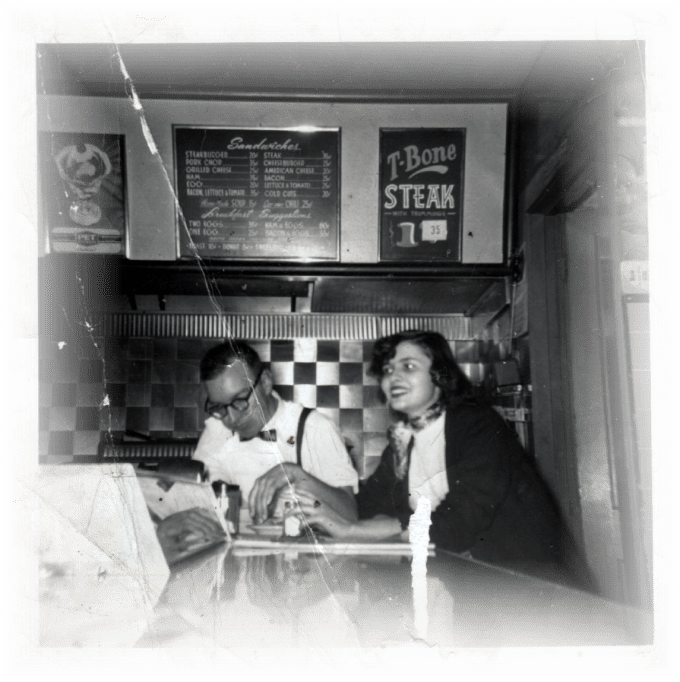


 Marionetta Strung-Out